Jenny Holzer Whispering against the City Walls
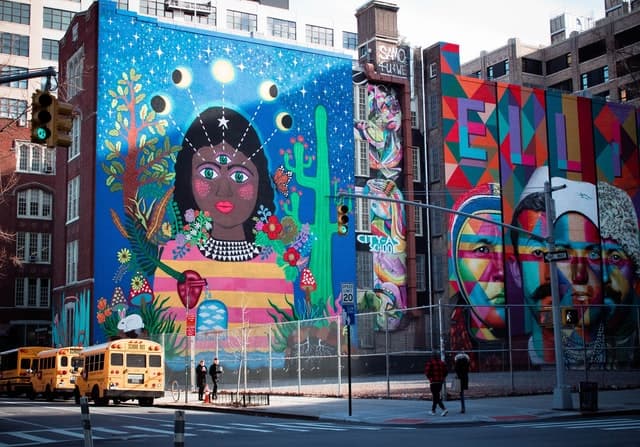
Jenny Holzer’s art revolves around outspoken texts that inhabit posters and signs, namelessly disseminated through the city. The ungendered authority voice in her first written pieces, Truisms (1977-1987) and Inflammatory Essays (1978-1982), allowed her to avoid any associations with femininity as traditionally understood, fuelling passers-by's critical reflection.Later in her career, in parallel with her efforts to establish herself on a phallocentric art scene, Holzer’s production found placement within more institutionalised museum contexts. Nonetheless, anonymity still remains a constant in Holzer’s work and is thus not secondary to her outputs. Yet, most of the time, this was partially overlooked by scholars in favour of different conceptualisations of her work. Hence, this article aims to bridge this gap in the literature by analysing how Holzer adopted voices different from hers in the early stages of her career. The goal is to understand the rhetorical strategies she employed to find a place in a male-dominated art world and cityscape. By inquiring the self-fashioning of an unnamed identity, it will be remarked how the notion of persona is constantly evolving through time and space. It will be further argued that she appropriated authoritative voices far from her own, adapting them to address the public by proposing gestures of activism on topical issues of undoubtful relevance, directly intervening in the public space.
Vol. 7 No. 3 (2022): Art and Activism in Public Space
Keywords:
Public art, Feminism, Jenny Holzer, Persona Studies, Rhetorical Analysis
The Journal of Public Space
2 min read
City Space Architecture
Exhibition
Sep 7, 2023
European Prize for Urban Public Space
On 1-30 September 2023 Museo Spazio Pubblico hosted the exhibition of the 2022 edition of the European Prize for Urban Public Space, a biennial initiative promoted by the Centre for Contemporary Culture of Barcelona (CCCB). The CCCB is a multidisciplinary cultural centre that deals with the key challenges of contemporary society through different languages and formats, with an extensive programme that includes major thematic exhibitions, series of conferences and literary meetups, film screenings and festivals.
The exhibition of the European Prize for Urban Public Space has already travelled in Europe and beyond (you can read more here). This is the first time the exhibition is hosted in Bologna, on the occasion of the first workshop of the Public Space Academy promoted by City Space Architecture and taking place at Museo Spazio Pubblico.
The exhibition also falls in the celebration of the 10-year anniversary of City Space Architecture (read more here). The opening of the exhibition of the European Prize for Urban Public Space on Friday September 1st at 6pm at Museo Spazio Pubblico was welcomed by the Deputy Mayor of Bologna Anna Lisa Boni and introduced by Elisabet Goula, Head of the Prize.
The exhibition was set up in the indoor space of Museo Spazio Pubblico and in the oudoor space of Il Giardino, the adjacent public garden managed by City Space Architecture in the framework of a cooperation agreement with the Municipality of Bologna for the care and regeneration of urban commons.
Read more about the exhibition in the invitation we sent through our newsletter here.
The exhibition also included an art work by Michele Liparesi from his well-known collection Bestiary.
On September 4th, City Space Architecture hosted a thematic session of the European Prize for Urban Public Space, during a public seminar organized in collaboration with Fondazione Innovazione Urbana, in the workspace of Bologna Attiva – Temporanea at DUMBO.
Thematic session | European Prize for Urban Public Space
Introduction with David Bravo , Former secretary of the Prize Jury (2010-2018)
Lecture by Wim Voogt , OKRA Landschapsarchitect, Netherlands
Winner of the 2022 European Prize for Urban Public Space
Lecture by Paul Steinbrück , Flow, Belgium
Finalist of the 2022 European Prize for Urban Public Space
Lecture by Renate Lagzdina , Gardens of Sporta pils, Latvia
Finalist of the 2022 European Prize for Urban Public Space
Museo Spazio Pubblico
2 min read
Urban Life & Experience
Public Space
Arts & Culture
Community & Participation
Portfolio
Creative Practices
Dec 20, 2020
Alfombrismo: Ephimeral Art Utopia
The way in which we experience public space is closely related to the sociocultural and environmental conditions of the context.Similar to the garden – in the strict philosophical sense- Traditional Tapestry ephemeral art represents a utopia; it stands for an aesthetic theory of beauty and a vision of happiness. Traditional ephemeral art is conceptualized as a utopian space where diverse elements, people, as well as a wide variety of activities converge; those are the ones who transform reality through cultural expression, exploring habits and values which pursue a common goal in a livingly way, and improve social coexistence.Tapestry ephemeral art temporarily and actively transforms their surroundings. It is in that public space where it is embraced that a dialogue is modelled; a dialogue where not only formal appearance but also designing constructive one converge, as an artistic, philosophical, and spiritual expression of its community itself.Such artistic intervention allows physical proximity; in a whole overview vision of urban context, design displays Mexican art values and transforms public space. The greater the proximity, the greater the change in the scale of the work, therefore, it is possible to feel immersed in the piece and identify the natural material, which in its arrangement and place, reveals the garden utopia –symbol of harmony between itself and the atmosphere portrayed in a living work of art.Nowadays, the isolated streets in many different parts of the world reflect a universal reality which urges a re-connection with the natural environment to which we belong, as well as a transformation of the sociocultural interactions that emerge from responsibility, equality and the common good.
Vol. 5 No. 4 (2020): Art and Activism in Public Space
Keywords:
public space, ephemeral art, cultural expression, espirituality, community, traditional tapestry
The Journal of Public Space
2 min read
Global
May 6, 2022
What is Tactical Urbanism?
Today, one of the most popular initiatives regarding public space, participatory design and activism in the city is the so-called citizen urbanism or tactical urbanism. The approach proposes to trigger, through limited and low-cost interventions, long-term changes in public space, i.e. short-term action, long-term change (Street Plans, 2013).
The strategy used is to create temporary scenarios that make visible a specific problem and the formation of specific interventions to solve it, seeking to incorporate the community to give it relevance and promote its sustainability over time and, in this way, raise the discussion about the benefits of the projects for the quality of life in the context in which they are inserted.
Based on this mode of operation, and in order to facilitate its implementation, they have developed intervention guides that provide instructions for design, materiality and execution, in order to conduct and operationalise the entire process, from conception to construction. The first guide to tactical urbanism emerged in 2012 in the United States by planner Mike Lydon and architect Tony Garcia. Subsequently, new case-related publications have been added in Australia, New Zealand, Italy and Latin America. In 5 years alone, 10 publications have been produced in English and Spanish, compiling examples of urban interventions around the world. (Street Plans & Ciudad Emergente, 2013).
Read the full article on archdaily Author: Consuelo Araneda Recommended by Stephanie Cheung
Mastering Public Space
2 min read
Artist
Viewpoint
Named Places & Projects
Arts & Culture
Organizations & Institutions
Europe
Dec 30, 2018
Art as a catalyst to activate public space: the experience of ‘Triumphs and Laments’ in Rome
Many cities have rediscovered and reinvented their river fronts as public spaces in recent years. From New York to Seoul, urban waterways which were forgotten, marginalized, or outright abandoned are now filled with life. In each case the transformation was spurred by a combination of grass roots, bottom-up initiative and savvy government recognition of the projects’ potentials. Once the city leaders embraced the projects - and not a moment sooner - public and private funding materialized and bureaucratic barriers disappeared.In Rome, whether due to the complexity of the chain of responsibility for the river front, or simply an ingrained aversion to progressive planning - saying no or saying nothing is much easier than taking responsibility for positive change - initiatives to renew the urban riverfront have been small and disconnected. Diverse interests ranging from green space to water transit, from river front commerce to ecological restoration, have all vied for a role in the river’s regeneration.But one particular discipline, that of art, has succeeded more than others in attracting international attention and changing the way people in Rome and throughout the (art) world see the Tiber. Artist William Kentridge, with his project ‘Triumphs and Laments’, using the simple technique of selective cleaning of the Tiber embankment walls, revealed to the world a procession of figures which populate the riverfront with a life that it hasn’t seen in centuries.
Vol. 3 No. 3 (2018)
Keywords:
Rome, William Kentridge, art, Triumphs and Laments, Tiber Riverfront, Associazione Tevereterno Onlus
The Journal of Public Space
2 min read
Africa
Social Justice & Equity
Public Space
Community & Participation
Academic
Dec 30, 2022
Rethinking Public Open Space in Khartoum’s Low-income Neighbourhoods
Lessons from African Cities
For half a century, continuous political and economic challenges in Khartoum, Sudan have perpetuated social inequity in the urban environment across generations. Poor-quality informal public open spaces compensate for the absence of accessible developed public spaces for the urban poor. Although there is a high supply and distribution of public open spaces within low-income neighbourhoods, yet, they are hardly noticed as a development opportunity for enhancing an aspect of life quality. Thus, this paper attempts to utilise the above-mentioned possibility by asking the question of how can public open spaces in low-income neighbourhoods be utilised? Aiming to identify suitable strategies of improvement. Through an exploratory investigation with an inductive component on public open spaces in developing countries, with Khartoum State in Sudan as a focal point, the methods are based on observations, desk research, literature review, and analysis of case studies. Furthermore, by highlighting the importance of public open spaces to individuals and local communities in the literature review, this study generates an Integrated Tri-pillar Framework (ITF) that is based on society, built environment, and economy to define overlapping contextual placemaking approaches and strategies for improving neighbourhood public open spaces in developing countries like Sudan. The framework links theory to practise, and is mobilised through analysing and interpreting analogous case studies on the success of public open spaces in African cities that share similarities in context with Khartoum, Sudan. The analysis hints at the possibility of empowering groups to take control in shaping their surrounding environment could lead to a greater sense of ownership and responsibility towards public spaces, potentially contributing to the creation of more active inclusive spaces. Finally, this study attempts to add to the limited academic work on this topic in Sudan, and concludes with holistic recommendations for upgrading public open spaces at the neighbourhood level.
Vol. 7 No. 1 (2022): Public Space and Placemaking in African Cities
Keywords:
Khartoum, Africa, informal public open spaces, spatial injustice, bottom-up